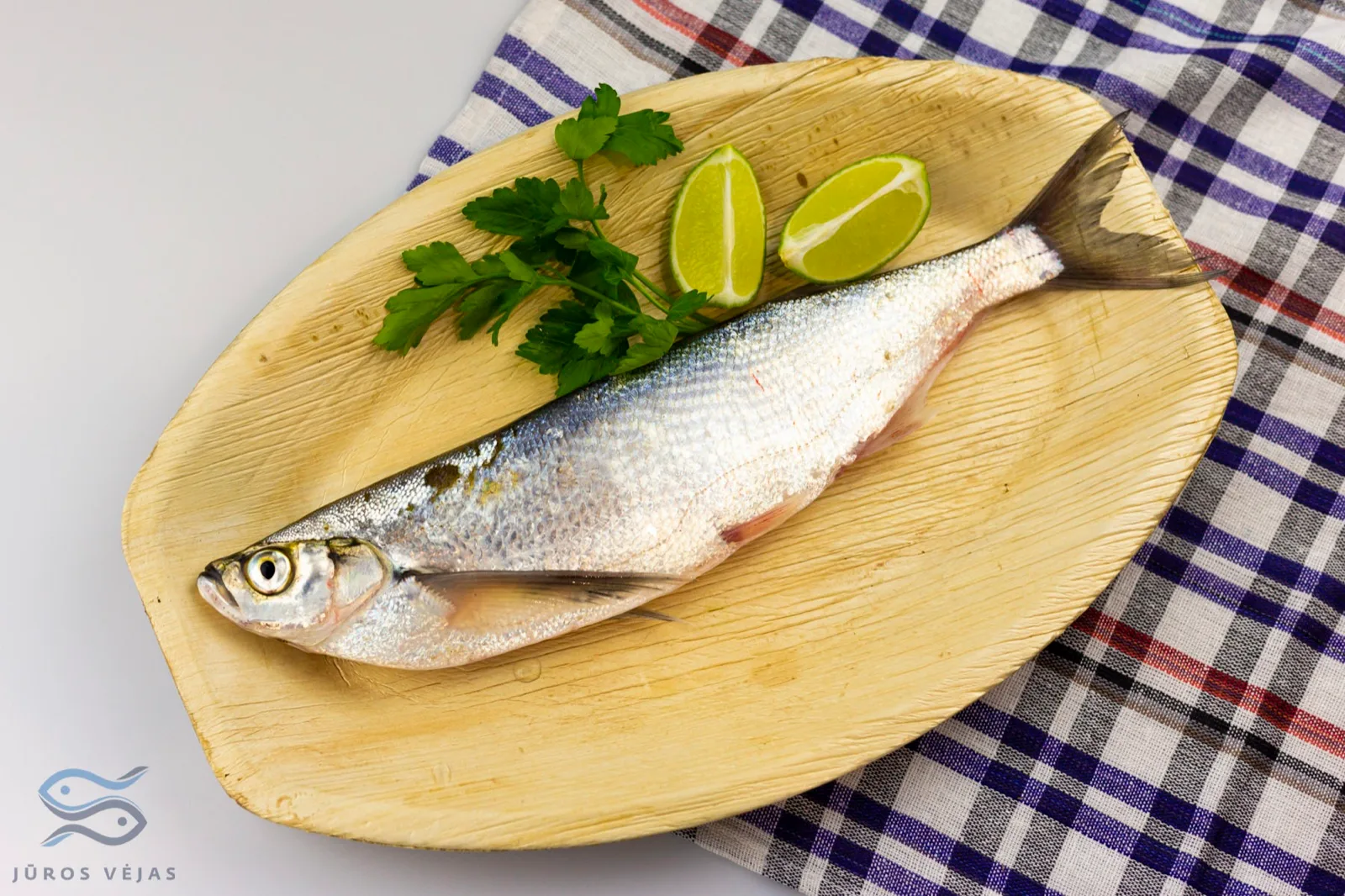
Sabrefish
Pelecus cultratus
Products (2)
| Product | Package | Origin |
|---|---|---|
| Ungutted, chilled | 1 kg | Lithuania |
| Ungutted, frozen | 1 kg | Lithuania |
About sabrefish
The sabrefish (Pelecus cultratus), also known in Lithuanian vernacular as ‘peslys’, is a pelagic fish of the carp family (Cyprinidae) that lives in both fresh and brackish waters. It has an elongated, strongly laterally compressed silvery body, an upturned mouth, a sharp scaleless keel along the belly and long, wing-like pectoral fins. It gathers in schools in the upper layers of the water. It is distributed in the basins of the Baltic, Black and Caspian Seas; in Lithuania it is most abundant in the Curonian Lagoon and the lower reaches of the Nemunas. The fish most commonly caught weigh around 0.5 kg.
Nutritional value
It is a lean, protein-rich fish whose flesh contains little fat and relatively few calories. It provides complete protein, B vitamins and minerals — phosphorus, potassium and magnesium. Like other cyprinids, it accumulates a certain amount of beneficial fatty acids, which makes it suitable for a variety of dietary approaches.
Fishing seasonality
Sabrefish is at its oiliest and most valuable in autumn, before it overwinters in deeper waters. In spring, in May, it spawns in the lower reaches of rivers. The size and fat content of the catch vary with the time of year and the fishing area.
Culinary notes
Sabrefish has delicate, quite tasty flesh, but it is very bony, which is why it is particularly valued smoked — both hot and cold smoking soften the small bones. It is also suitable for air-drying, marinating and frying. It pairs well with lemon, onions, aromatic herbs and acidity, which dissolves the bones.